
Blog · 2026-11-05
Do You Wish You'd Taken More Risks? How Fear Holds Us Back
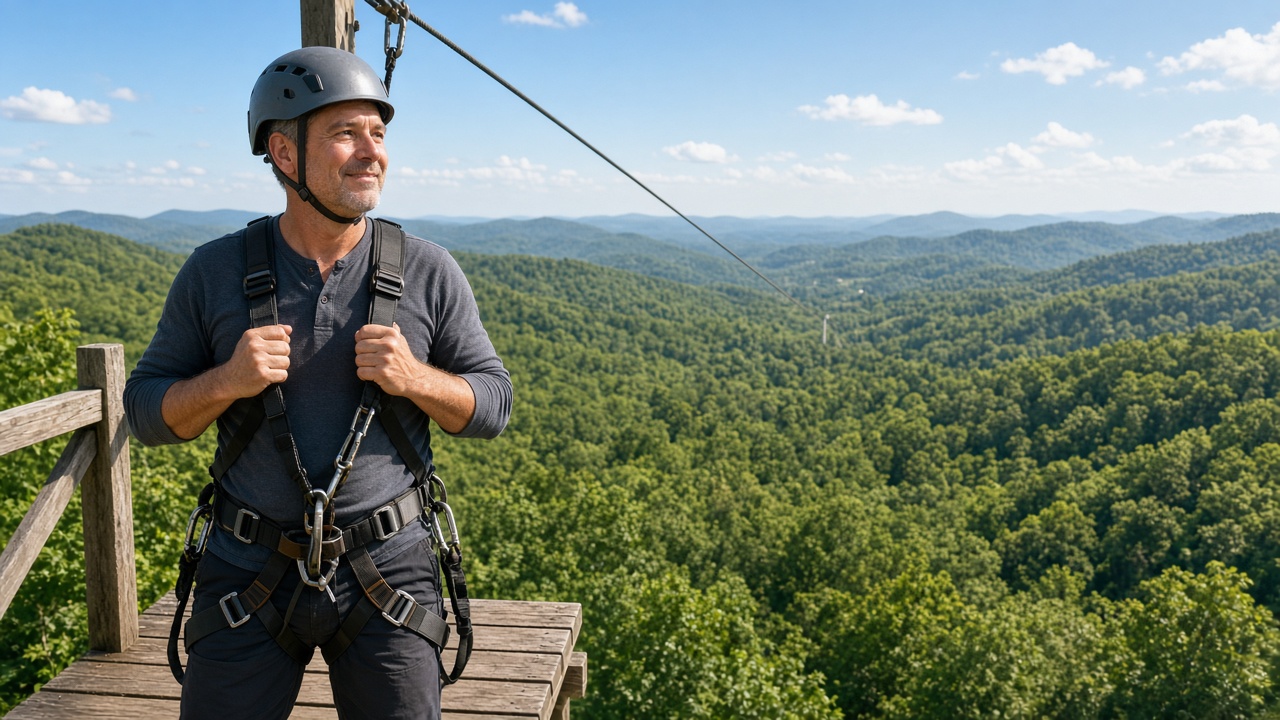
Think of something you almost did. You almost spoke up in the meeting. You almost asked that person to coffee. You almost applied for the job. New research suggests that "almost" is very common, and that it may cost us more than we think. The good news is that the thing holding most of us back is not our circumstances. It is our feelings. And feelings are something we can learn to work with.
What did the research find?
Writer Rob Henderson (@robkhenderson) recently shared a page from a new book on X. The book is The Opposite of Happiness by George Loewenstein, a well-known behavioral economist at Carnegie Mellon University. The page said that "about half of all respondents said they were dissatisfied with their overall risk-taking." Of those, "around six to one" wished they "took more risks in life, not fewer." And what held them back "was their emotions: fear, anxiety, self-doubt."
I wanted to see the study behind it. It was published in 2025 in the Journal of Risk and Uncertainty. The authors are Linda Thunström, Andrea Mannberg, Benjamin Gilbert and Loewenstein. They ran three surveys of U.S. adults, with about 1,200 people in all.
Here is what they found:
- About half were unhappy with their risk-taking. That was 54% in the first survey, 45% in the second and 52% in the third.
- Most of them wished they took more risks. In the first survey, 46% of people said they took too few risks. Only 8% said they took too many. That is where the "six to one" comes from. In the largest survey, the split was closer to four to one.
- It was mostly about everyday life. People were not sad about skipping skydiving. They named things like meeting new people, sharing their opinions and standing up for themselves. Work and money came up often too.
- Feelings were the main brake. In the second survey, people who took too few risks gave reasons like focusing on what could go wrong (65%), their emotions (63%) and lack of confidence (56%). In the third survey, most people said the cause was inside them, not their circumstances. Money was the main exception.
- It was linked to lower life satisfaction. People who were unhappy with their risk-taking, in either direction, were less satisfied with life. The gap was about as big as the gap between earning $37,500 and $75,000 a year.
The authors are careful, and I want to be too. These are surveys, so they show a link, not proof that taking more risks will make you happier. People who are unhappy in general may also feel unhappy about their choices. The authors also note that people who regret playing it safe may forget the real downsides of the risks they skipped.
Why "what if" stays with us
This fits older research too. Cornell psychologists Thomas Gilovich and Victoria Medvec studied regret in the 1990s. They found that in the short run, people regret things they did. But over the long run, people's biggest regrets tend to be things they didn't do.
There is also a timing trap. The risk study's authors point to research showing that people often plan to do something brave, like a bungee jump, and then freeze when the moment comes. When a scary moment is far away, we tend to think we'll be braver than we are.
How fear, anxiety and self-doubt work the brakes
Fear is not the enemy. It is built to keep us safe. The problem is that it often can't tell the difference between real danger and simple discomfort. Asking for a raise feels risky to the body, even though the worst likely outcome is a "no."
Anxiety adds "what if" thinking. Self-doubt adds "Who am I to try this?" Together, they make staying put feel like the safe choice. But staying put has a cost too. We just don't see it until later.
Mindfulness-based CBT tools for taking wise risks
In my work, I use mindfulness-based cognitive behavioral therapy (CBT) to help people with anxiety move toward what matters. Here are some tools you can try.
1. Notice the brake. When you feel yourself backing away, pause and name it: "This is fear," or "This is self-doubt talking." You don't have to make the feeling go away. You just have to see it for what it is.
2. Separate danger from discomfort. Ask, "Is this actually dangerous, or just uncomfortable?" Most social risks, like speaking up or saying hello, are uncomfortable but safe.
3. Test the thought. Write down the scary prediction: "If I speak up, everyone will think I'm stupid." Then ask: What is the worst case? The best case? The most likely case? Could I handle the worst case?
4. Climb a ladder. Don't start with the biggest risk. List small steps from easiest to hardest. Maybe you start by sharing one idea in a small meeting before you lead a big one. Each step teaches your brain that you can handle it.
5. Let your values decide. Ask, "Who do I want to be? Ten years from now, what will I wish I'd done?" Then let that answer, not the fear, make the call.
6. Breathe and take the step. You may never feel ready. Slow your breathing, feel your feet on the floor, and act while the fear is still there. Courage isn't the absence of fear. It's moving with it.
7. Check for the opposite problem. Some people take too many risks, often out of impulse or a need for a thrill. If that's you, the same pause helps. Wise risk-taking means acting on your values, not on the feeling of the moment. Sometimes that impulse comes with anger. I wrote about that in Fragile Ego, Short Fuse.
When to get more help
Consider talking with a counselor if:
- Fear or worry keeps you from things you really want, like relationships, a new job or speaking up.
- You avoid more and more situations over time.
- Self-doubt feels loud most days.
- You keep looking back with "what if" and can't let it go.
Anxiety is very treatable, and you don't have to push through it alone.
Your next small risk
You don't need to change your whole life this week. Just pick one small risk that matters to you, and take it. If fear, anxiety or self-doubt keeps winning, I'd be glad to help. I work with adults in Franklin, TN, and across Tennessee by telehealth, using mindfulness-based CBT.
This post is for educational purposes only and is not a substitute for counseling, therapy, or medical advice. If you are in crisis, call or text 988. In an emergency, call 911.
Sources
- Rob Henderson (@robkhenderson). Post quoting The Opposite of Happiness on risk-taking. X, Nov 4, 2026.
- Loewenstein G. The Opposite of Happiness: How Bad Feelings Make and Break Us. 2026 (p. 52, as shown in Henderson's post).
- Thunström L, Mannberg A, Gilbert B, Loewenstein G. "(Dis)satisfaction with risk preferences." Journal of Risk and Uncertainty 70(1):29–64 (2025). doi:10.1007/s11166-025-09449-7
- Gilovich T, Medvec VH. "The temporal pattern to the experience of regret." Journal of Personality and Social Psychology 67(3):357–365 (1994).
- Gilovich T, Medvec VH. "The experience of regret: What, when, and why." Psychological Review 102(2):379–395 (1995).
- Van Boven L, Loewenstein G, Welch E, Dunning D. "The illusion of courage in self-predictions: Mispredicting one's own behavior in embarrassing situations." Journal of Behavioral Decision Making 25(1):1–12 (2012).
Related at Navigate Life Counseling: anxiety counseling in Franklin, TN.