
Blog · 2026-11-04
Your Kids Are Watching You Argue. Here's What Actually Matters.
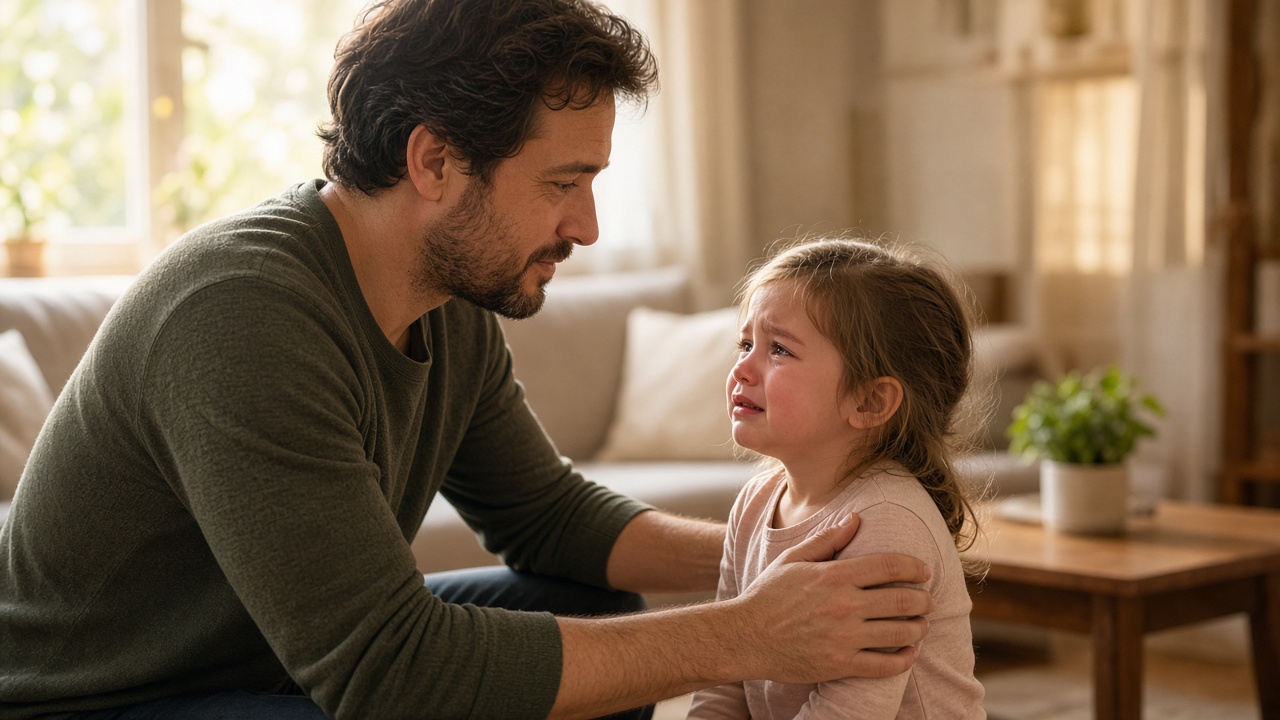
Even babies notice when grown-ups get angry, and they change how they act because of it. That can sound scary if you have a temper. But the research also brings good news. Kids don't need parents who never disagree. They need parents who disagree with care and then make things right where the kids can see it.
What did the University of Washington study find?
A post on X caught my eye this week. It said that 15-month-old babies are "already reading the room." It shared a short video from a lab study. In it, a toddler is happily playing with a friendly adult. Then another woman speaks to that adult in an angry voice. After that, the toddler holds back and stops playing the way they did before.
I went and found the actual research. It comes from Betty Repacholi and Andrew Meltzoff at the University of Washington's Institute for Learning & Brain Sciences. Here is what they did.
In a 2014 study, 150 toddlers, all 15 months old, sat on a parent's lap. They watched an adult show how to play with some toys. Then a second adult came in and reacted to the toy play in an angry voice. She called it "aggravating" and "annoying." Her anger was aimed at the other adult, not the child.
Next, the toddlers got a turn with the toys. If the angry adult had left the room or turned her back, the toddlers grabbed the toys and played. But if she was facing them, even with a calm face, most toddlers waited about four seconds before touching the toy. They were also less likely to copy what they had seen.
In other words, the babies were listening in on a grown-up conflict. Then they used what they learned to stay out of trouble.
Babies remember who got angry
Two follow-up studies came out in 2016. In one, 270 babies watched the same kind of setup. Later, the once-angry adult acted calm and neutral. The babies still held back around her.
"It's as if the baby doesn't trust that the Emoter is now calm," Repacholi told UW News. ("Emoter" is the name the lab gave the adult who showed the feeling.)
In the other study, 72 babies got to play with a fun, light-up toy. Then the adult asked for a turn. Among babies who had seen her get angry earlier, 69% handed the toy over. Among babies who had seen her stay neutral, 46% did. Repacholi said it was "like they were appeasing or compromising with the adult."
To be fair, these were strangers in a lab, not moms and dads at home. The studies do not show that one argument harms a child. What they do show is how early kids start tracking the mood of the adults around them.
So should parents never argue in front of kids?
No. This is the part I want parents to hear.
Psychologist E. Mark Cummings has studied kids and parent conflict for decades. His work, with colleagues, splits conflict into two kinds.
- Destructive conflict looks like hostility, insults, threats, and verbal or physical aggression.
- Constructive conflict looks like problem solving, support, and affection.
In one home study, 51 couples kept diaries about their everyday arguments and how their kids reacted. Destructive tactics and strong negative emotion went along with kids feeling less secure. Constructive tactics went along with kids feeling more secure.
How the fight ends matters too. In a 1991 study, children watched videos of adults in conflict. Some conflicts ended with an apology or a compromise. Some ended with a change of topic. Some never ended at all, with more fighting or the silent treatment. Children reacted most negatively to the conflicts that never got resolved. A clear ending made a real difference.
A 2007 study by Goeke-Morey, Cummings, and Papp found the same thing in real homes. Kids pay close attention to how arguments end, and they notice what an ending means for the family.
So the goal is not zero conflict. The goal is calm disagreement and a repair kids can see.
What if anger is your struggle?
Many of the parents I work with love their kids deeply. They just have a short fuse. They snap, then feel awful. If that's you, you're not a bad parent. You're a parent with a skill to build.
Anger often shows up fast because it's covering something softer, like fear, hurt, or feeling overwhelmed. I wrote more about that in What Is Your Anger Covering Up?
Five steps for calmer conflict in front of kids
These come from the mindfulness-based CBT tools I use with clients.
1. Notice your body first. Anger shows up in the body before it shows up in words. Think of a tight jaw, a hot face, a raised voice. When you catch it early, you have a choice.
2. Pause out loud. Try saying, "I'm getting too heated. I need ten minutes, and then I'll come back." This models self-control. Kids see that big feelings can be handled.
3. Check the story. Ask yourself, "What am I telling myself right now? Is it fully true?" Anger often says the other person is the problem. Most of the time, it's more mixed than that. My post Is Your Anger a Signal or a Verdict? walks through this check.
4. Keep the topic small. Talk about this one problem. Skip "you always" and "you never." Lower your voice and slow down.
5. Repair where the kids can see it. If they saw the argument, let them see the ending. A hug, a "we figured it out," or a simple "I'm sorry I raised my voice" all count. With older kids, you can name it: "Mom and Dad disagreed, and we worked it out. You didn't cause it."
If you snapped at your child directly, repair with them too. Get down on their level and say, "I yelled, and that wasn't okay. I'm working on it. I love you." That one minute teaches more than a perfect day ever could.
When to get more help
Consider talking with a counselor if:
- Arguments at home happen most days or often turn into yelling.
- Fights rarely get resolved and just go quiet.
- Your kids seem to tiptoe around you or get upset when voices rise.
- You keep promising yourself you'll stay calm, then you don't.
These patterns are common, and they can change with practice and support.
Ready to fight fair and repair well?
Your kids are watching. That's not a reason for shame. It's a chance to show them that people who love each other can disagree and come back together. If you'd like help taming your temper and learning to repair, I'd be glad to work with you. I see adults in Franklin, TN, and across Tennessee by telehealth, using mindfulness-based CBT.
This post is for educational purposes only and is not a substitute for counseling, therapy, or medical advice. If you are in crisis, call or text 988. In an emergency, call 911.
Sources
- Camus (@newstart_2024). Post on toddlers "reading the room". X, Nov 4, 2026.
- Repacholi BM, Meltzoff AN, Rowe H, Toub TS. "Infant, control thyself: Infants' integration of multiple social cues to regulate their imitative behavior." Cognitive Development 32:46–57 (2014). doi:10.1016/j.cogdev.2014.04.004
- University of Washington News. "Toddlers regulate behavior to avoid making adults angry." Oct 7, 2014.
- Repacholi BM, Meltzoff AN, Toub TS, Ruba AL. "Infants' generalizations about other people's emotions: Foundations for trait-like attributions." Developmental Psychology 52(3):364–378 (2016).
- Repacholi BM, Meltzoff AN, Hennings TM, Ruba AL. "Transfer of social learning across contexts: Exploring infants' attribution of trait-like emotions to adults." Infancy 21(6):785–806 (2016).
- University of Washington News. "Better safe than sorry: Babies make quick judgments about adults' anger." Mar 21, 2016.
- Cummings EM, Ballard M, El-Sheikh M, Lake M. "Resolution and children's responses to interadult anger." Developmental Psychology 27(3):462–470 (1991).
- Cummings EM, Goeke-Morey MC, Papp LM, Dukewich TL. "Children's responses to mothers' and fathers' emotionality and tactics in marital conflict in the home." Journal of Family Psychology 16(4):478–492 (2002).
- Goeke-Morey MC, Cummings EM, Papp LM. "Children and marital conflict resolution: Implications for emotional security and adjustment." Journal of Family Psychology 21(4):744–753 (2007).
- McCoy K, Cummings EM, Davies PT. "Constructive and destructive marital conflict, emotional security and children's prosocial behavior." Journal of Child Psychology and Psychiatry 50(3):270–279 (2009). doi:10.1111/j.1469-7610.2008.01945.x
- Davies PT, Cummings EM. "Marital conflict and child adjustment: An emotional security hypothesis." Psychological Bulletin 116(3):387–411 (1994).
Related at Navigate Life Counseling: anger management counseling in Franklin, TN.